THIS WEBSITE USES COOKIES
We use cookies to personalise content, to provide social media features, and to analyse our traffic. By choosing 'allow all cookies', you consent to our cookies.
Training: First summer school hosted by the University of Perugia
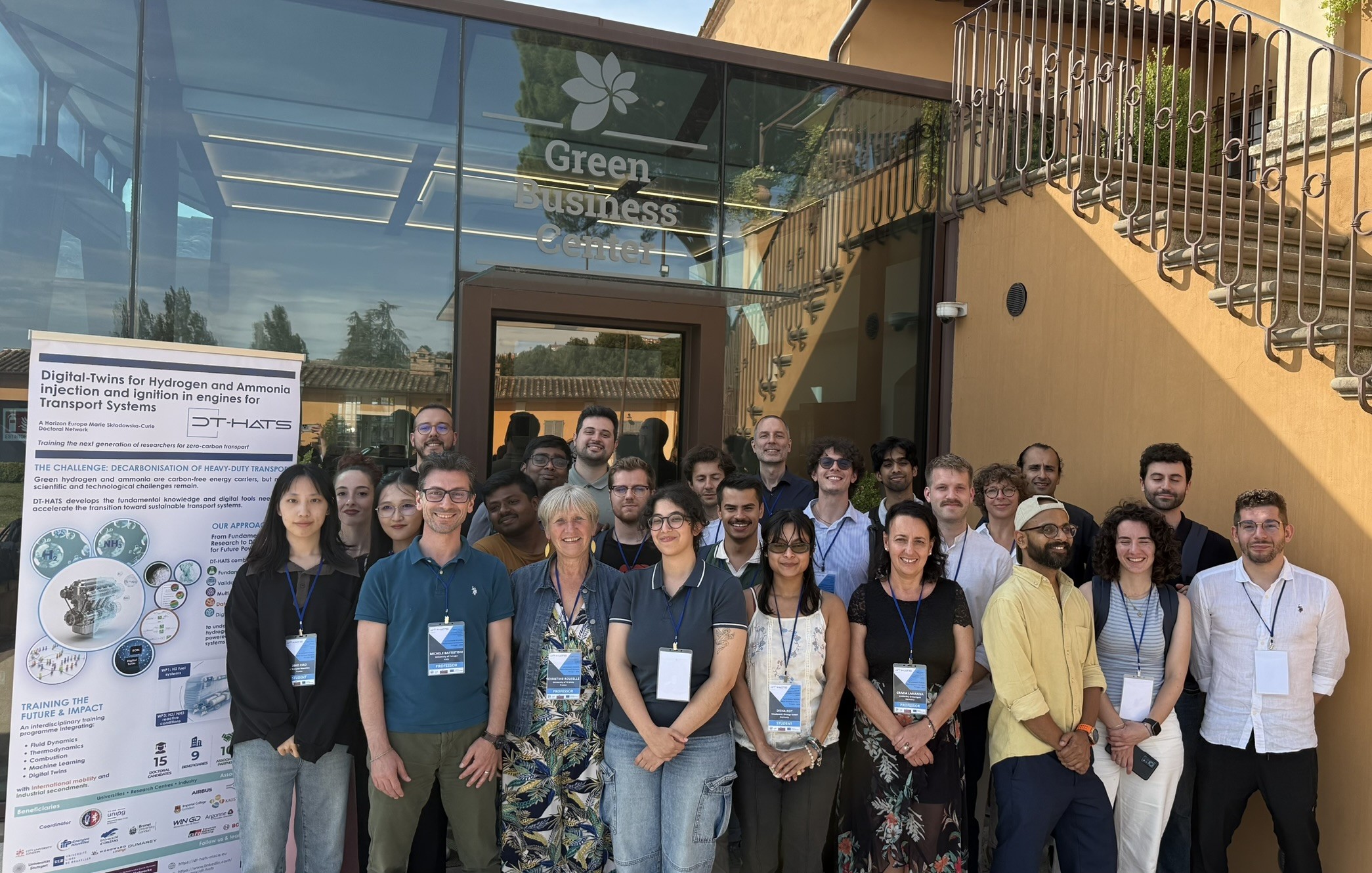
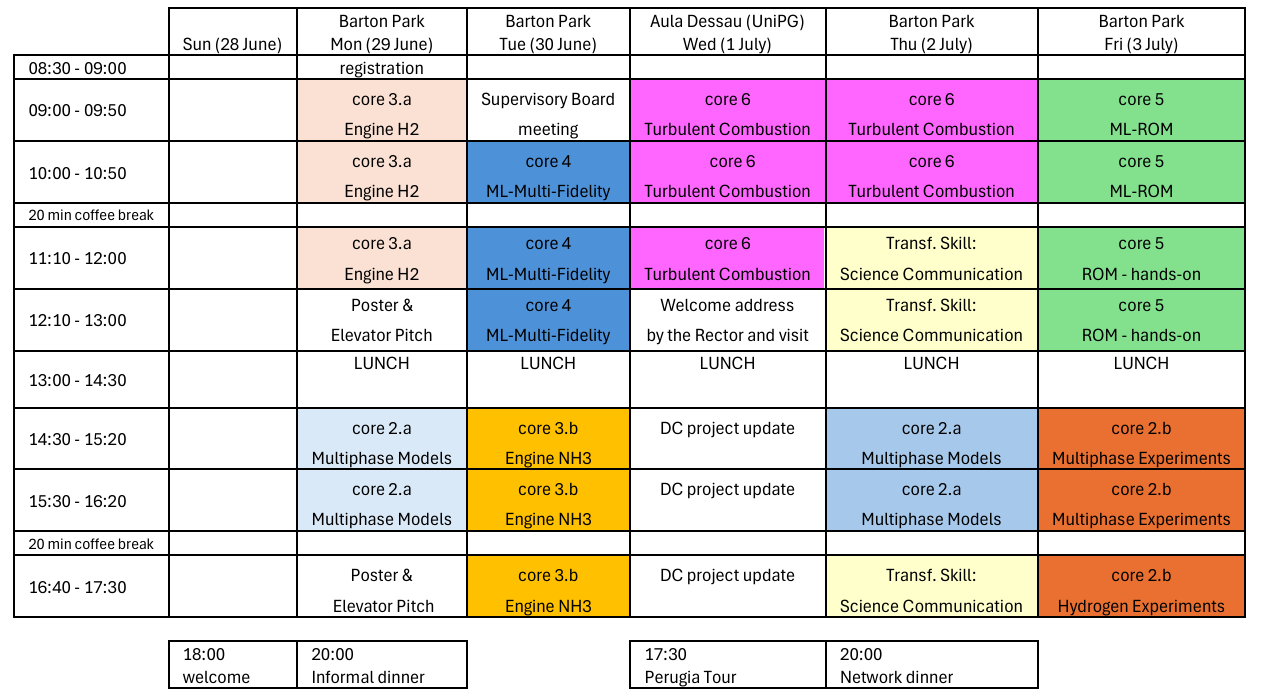
From 29th of June to the 3rd of July the Doctoral Candidates had the chance to meet each other for the first time during the Summer School hosted by the University of Perugia. During the week, several Professors held lectures on the relevant topics for the consortium. Hydrogen and ammonia injection, numerical and experimental investigations, machine learning, and much more were explored. An all-encompassing scientific training, alongside workshops on communication skills, was the main objective of the week.
Lecture on Hydrogen Engines by Prof. Zhao
Day 1 – 29th June 2026
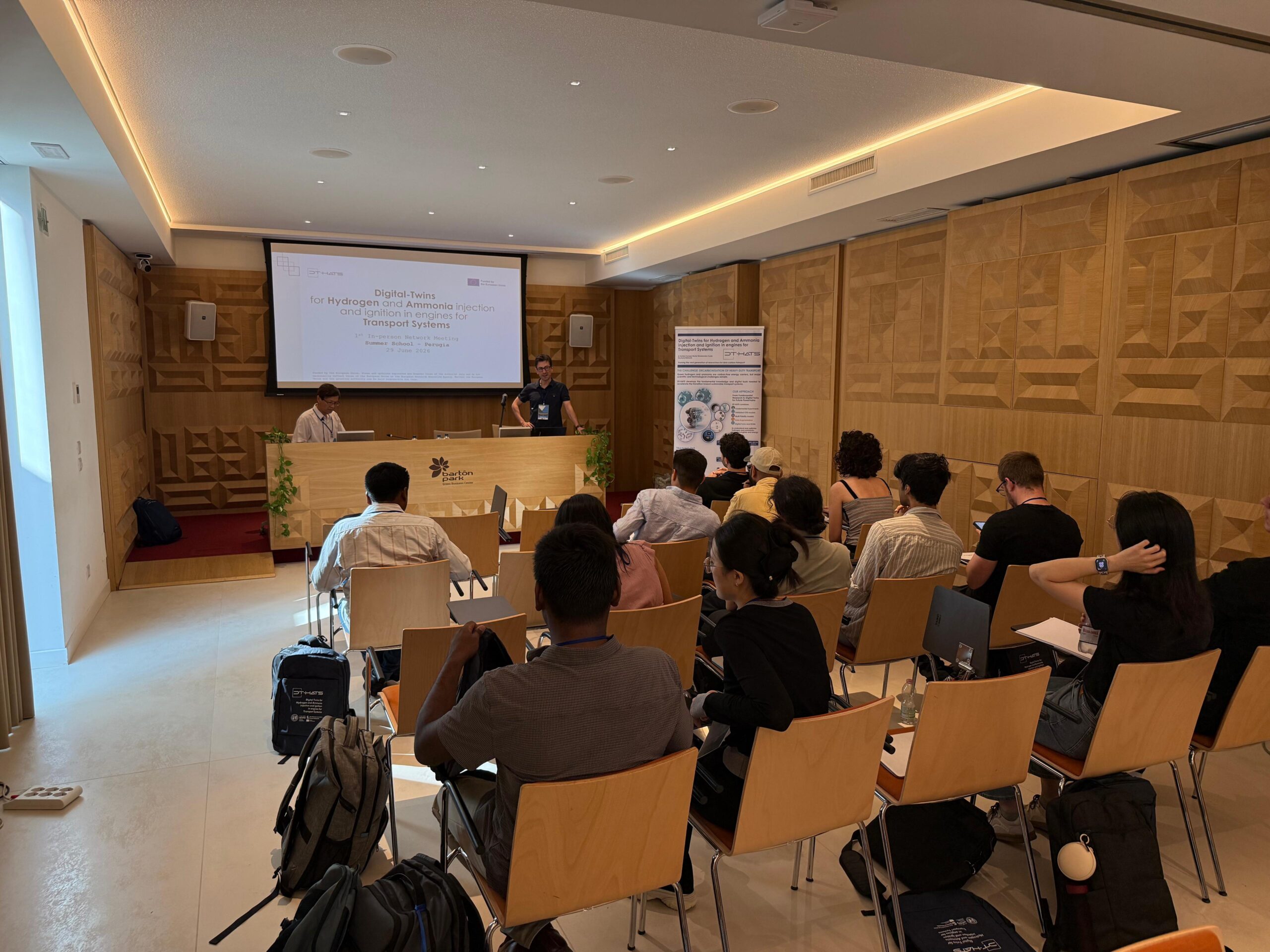
The first day of the Summer School started with Prof. Zhao (Brunel University of London, UK) talking about the modern automotive powertrain systems with a focus on hydrogen internal combustion engines. The lecture finished with Prof. Wang (Brunel University of London, UK) showing experimental results on Hydrogen-Ammonia dual fuel setup conducted at their test facilities.
After the lecture, took place, where all Doctoral Candidates had the opportunity to present their ongoing research activities or even first results of their work.
After Lunch, Prof. Battistoni (University of Perugia, IT) continued the lecture series with a deep dive into multiphase flow fundamentals, explaining the modelling and experimental work done in this field.
Day 2 – 30th June 2026
The second day started with a Supervisory Board meeting, where organisational topics were covered.
The rest of the morning was dedicated to a lecture by Prof. Mainini (Imperial College London, UK), highlighting the increasing influence of Digital Twins and different acquisition functions.
In the afternoon, Prof. Rouselle (University of Orléans, FR) held a lecture talking about the benefits of ammonia as a fuel and the research that’s being done on ammonia combustion engines.
DCs at the lecture on Digital Twins by Prof. Mainini
Day 3 – 1st July 2026
The third day started with Prof. Im (King Abdullah University of Science and Technology, SA) holding a lecture on Turbulent Combustion, talking about the challenges in this research. His second lecture of the day focused on statistical theory of turbulence and turbulent combustion regimes.
Before lunch, we had the pleasure of receiving a tour around the University of Perugia, where we learned about the history of the University. The Rector welcomed us and gave a speech at the Rectorate.
After lunch, the doctoral candidates had the chance to update all parties involved about their advances in the project update meeting.
After this engaging session, DCs and supervisors explored Perugia’s historical corners during a guided tour of the city.
DT-HATS team and Summer School guests at the Network dinner
Day 4 – 2nd July 2026
The 4th day, Prof. Im concluded his series of lectures by discussing the application of data-driven methods to combustion.
Later that morning, Prof. Gavaises (City University London, UK) gave an insightful lecture on the simulation of fuel injectors, which usually handle liquid and gas at the same time (multi-phase flows).
In the afternoon, the DCs attended a Science Communication workshop, held by Joanna Plesniak and Johannes Ripperger (accelopment, CH). Through a brief discussion of the poster presentations, DCs explored different communication strategies to talk about their research more effectively.
The day ended with the Network dinner in the delightful city centre of Perugia, where the participants had the opportunity to strengthen their connections.
Day 5 – 3rd July 2026
On the last day of the Summer School, Prof. Procacci (Université Libre de Bruxelles, BE) explained how to simulate combustion in a time-efficient way by using Reduced Order Models (ROMs). In the second half of the lecture, the doctoral candidates practiced what they learned through hands-on exercises.
Lastly, Prof. Lamanna and Julian Härter (University of Stuttgart, DE) delved into some of the measurement techniques typically used in their laboratories. With a focus on the optical phenomena they exploit, the lecture gave a practical insight into the investigation of ammonia and hydrogen’s behaviour.
The first Summer School of the DT-HATS project is, thus, officially over. From scientific trainings with top experts to lively exchanges between peers and workshops on transferrable skills, the participants spent the week in a stimulating and enriching environment. The DCs were able to grow as well-rounded researchers, while establishing strong connections for later phases of the project.
Here you can find what some of the DCs said about the first DT-HATS Summer School:
"It was really fun meeting and working with the other DCs. I’m excited to collaborate and produce impactful research!"
“The DT-HATS Summer School was a fantastic opportunity to learn, collaborate, and meet inspiring people. I leave with new knowledge, fresh ideas, and lasting connections. The combination of excellent lectures, hands-on discussions, and networking made it an unforgettable experience that motivated me to continue exploring this exciting field."
“The Summer School reminded me that research is more than scientific discoveries, it’s also about the people you meet, the ideas you exchange, and the collaborations you build along the way.”.
DCs discussing their research topics during a break