
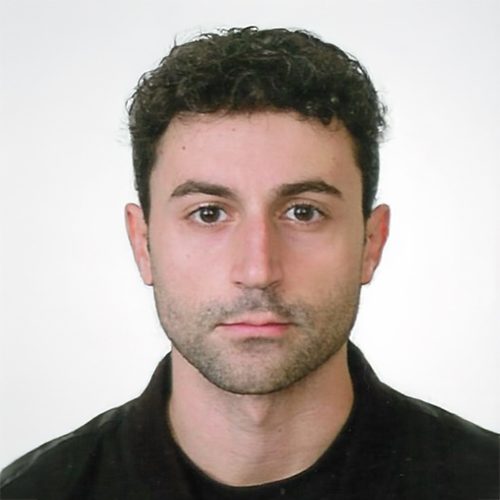
Dimitrios Chondroudakis
DC12: JAX fluids for modelling of dispersion and mixing of Liquefied H2 jets and H2-NH3 mixtures
In this project, I will study and simulate the dispersion and mixing of liquefied hydrogen jets. These processes are relevant to real-world situations such as the potential leakage of liquefied hydrogen from storage or transport systems, where understanding how the released fuel behaves is important for safety and design.
My work will involve performing numerical simulations to analyse the behaviour of these mixtures under different conditions and evaluating the accuracy and computational efficiency of the simulation tools by comparison with experimental data and other modelling approaches.
Supervisor Prof. Manolis Gavaises hosted by

1st secondment: industry hosted by

About me
I hold a Diploma in Mechanical Engineering (2025) from the National Technical University of Athens (NTUA).
During my studies, I developed a strong interest in computational fluid dynamics (CFD), numerical methods, and scientific computing. My academic interests focus on the numerical modelling of complex fluid flows such as compressible and multiphase flows, as well as the development and analysis of numerical methods used in modern CFD solvers.
My diploma thesis focused on h-refinement techniques for tetrahedral meshes. This work was later extended as a research activity towards refinement methods for hybrid meshes. The software I developed was integrated into the hosting laboratory’s in-house CFD solver. This experience allowed me to engage in a real research environment, strengthening my technical skills and gaining practical hands-on experience working with CFD frameworks and the software challenges involved in their development.
Through the DT-HATS doctoral network, I aim to expand my expertise in advanced computational modelling and contribute to research as part of my doctoral project. I am particularly excited about the opportunity to collaborate within an international research environment and take part in the activities of the network.
Curiosity about the behavior of physical systems and how we can model them efficiently is what drives my research. Within DT-HATS, I am excited to explore these ideas in the context of hydrogen and ammonia energy systems.